A commercial property can sit unattended for long stretches outside trading hours. Cameras may keep recording and the alarm may stay armed, but that raises the question that matters: who becomes aware of a security event when no staff are on site?
This is where commercial security monitoring in Perth becomes relevant. The difficulty is that “24/7 monitoring” is used to describe several different things. Continuous recording, phone notifications, remote camera access and a professionally monitored alarm are sold under the same phrase and do very different jobs.
This guide explains what each one does, how a back to base alarm works, what a typical monitored response involves, and how to work out which arrangement suits your premises.
Quick answer: what is 24/7 commercial security monitoring?
24/7 commercial security monitoring refers to security arrangements that remain active around the clock, potentially including alarm monitoring, CCTV recording, remote access, event alerts or professional monitoring. Recording and live professional monitoring are not the same thing, so businesses should confirm exactly what a proposed service includes.
What “24/7 security” actually means
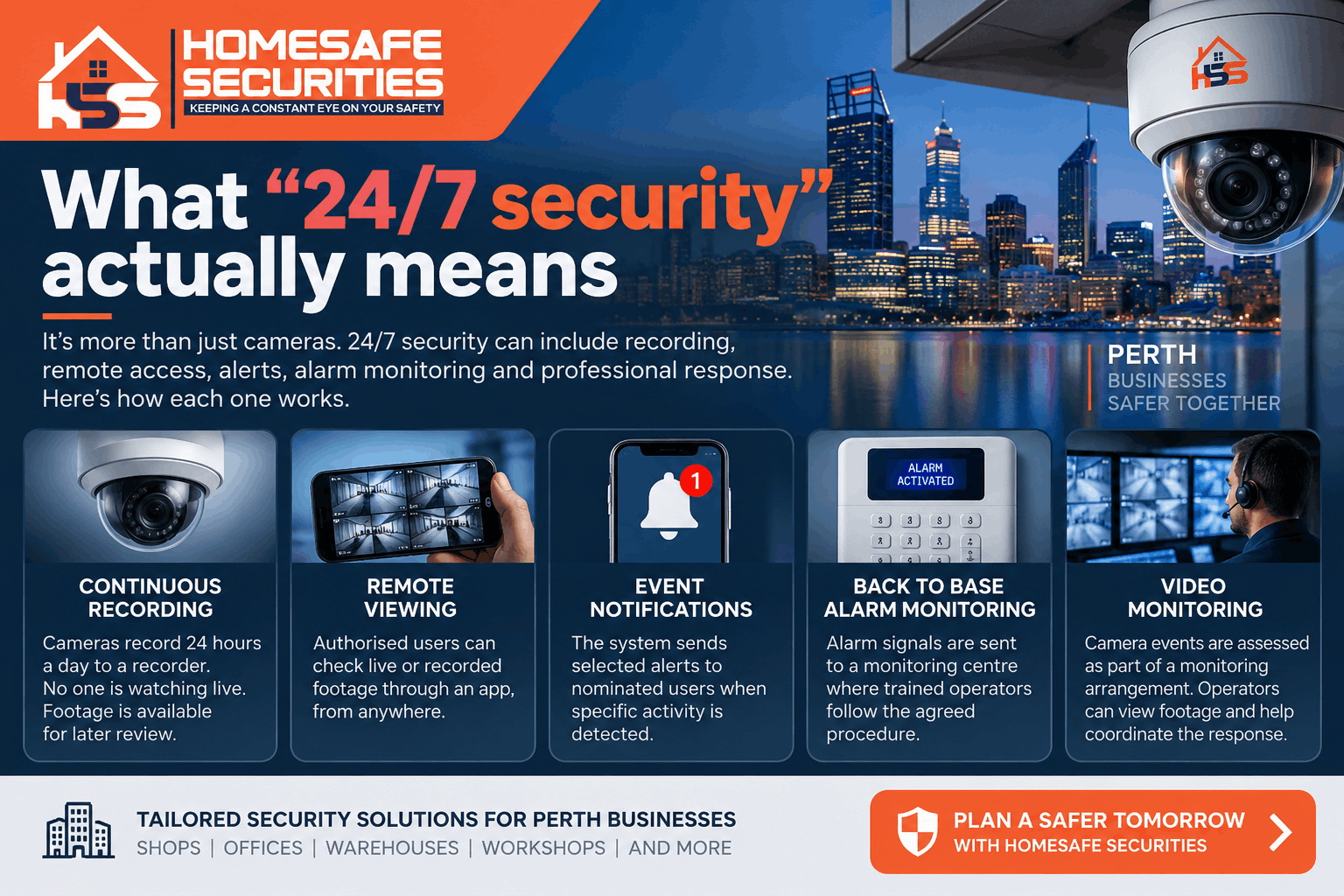
The phrase covers several capabilities, and the gap between them matters most at 3am.
| Function | What it does | Who responds |
| Continuous recording | Cameras record to the schedule set on the recorder | Nobody at the time — it is evidence for later |
| Remote viewing | Authorised users open an app and check the site | You, when you look |
| Event notifications | The system sends selected alerts to nominated users | You, if you are available |
| Back to base alarm monitoring | Alarm signals are sent to a monitoring centre | A trained operator, under the agreed procedure |
| Video monitoring | Camera events are assessed as part of a monitoring arrangement | A trained operator, under the agreed procedure |
Recording and app alerts give you information. A monitored arrangement is what produces a response. Many businesses believe they have the second and in practice have the first.
Which security monitoring setup might suit your business?
| Business need | Option to consider |
| Review events after they happen | CCTV recording |
| Check the premises remotely | Remote CCTV access |
| Know when an alarm zone activates | Alarm alerts or monitoring |
| Get visual context around an event | CCTV |
| Have events handled when staff are unavailable | Professional monitoring arrangement |
| Coordinate detection and visual information | Integrated alarm and CCTV setup |
Most businesses end up with a combination. The starting point is deciding which of those needs actually applies to your site.
What is a back to base alarm?
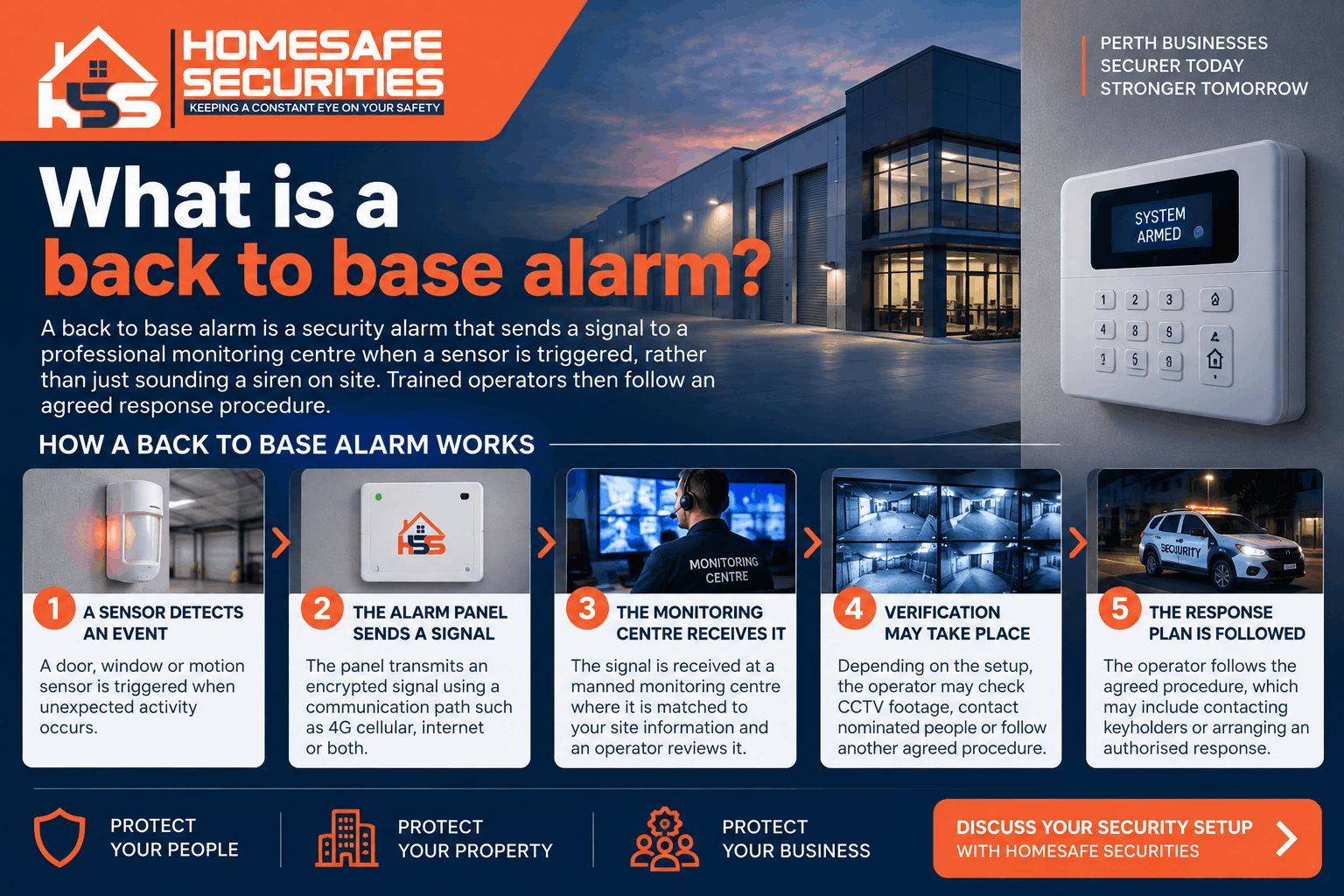
“Back to base” is the Australian term for an alarm that reports to a monitoring centre rather than only sounding on site. A sensor detects something, the panel sends a signal out over its communication path, and the monitoring centre receives it and follows the agreed procedure.
That communication path is worth checking. Many older security alarm systems were designed to transmit signals through traditional copper-based phone services, and compatibility could not simply be assumed when premises migrated to the NBN. nbn advises contacting your security alarm provider to find out whether your device is compatible before switching, noting that it cannot give general advice because of the range of alarm equipment in the market.
Current alarm systems may communicate over cellular, internet-based or dual-path connections. Where dual-path communication is configured, an alternative communication path may remain available if one connection fails. If your commercial alarm predates your property’s NBN transition, it is worth confirming that its communication path has been tested and is working.
A typical alarm-monitoring sequence
The exact process depends on the monitoring arrangement, but a monitored commercial alarm generally follows these stages:
- An alarm event occurs. A configured sensor or alarm zone activates.
- The signal reaches the monitoring arrangement. The event is identified using the site and zone information on file.
- Verification may take place. Depending on the system, this could involve reviewing available CCTV, contacting nominated people, or following another agreed procedure.
- The response plan is followed. This may include contacting keyholders or arranging another authorised response.
- The event is documented. Available event records help the business review what happened afterwards.
The two things that make this work are verification and a written response plan. Without verification, nobody knows whether it is an intruder or a loose roller door. Without an agreed plan, decisions are being improvised at 2am.
Can police be contacted after a commercial alarm activation?
The response to a security alarm depends on the circumstances, the information available and the procedures followed by the monitoring provider. Businesses should ask their provider how alarm verification, keyholder contact, patrol attendance and any escalation to emergency services are handled.
Do not assume that every alarm activation automatically results in police attendance. This is one of the most important things to clarify in writing before you sign.
Alarm monitoring vs CCTV monitoring
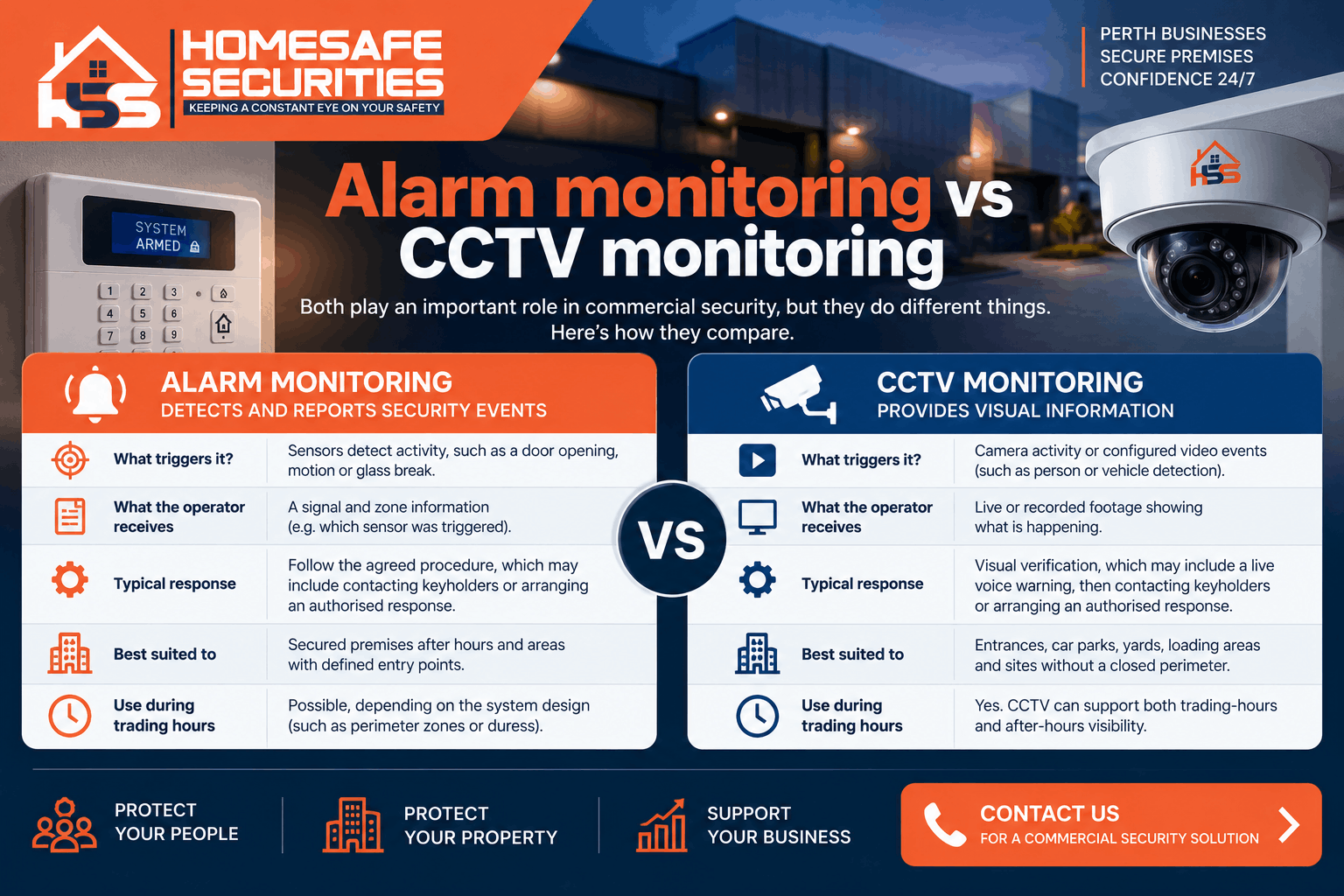
The two solve different problems, and businesses that get this right usually end up with both.
| Feature | Back-to-base alarm monitoring | CCTV / video monitoring |
| What sets it off | A configured sensor or alarm zone | Camera activity or configured video events |
| What the operator receives | A signal identifying the zone or event | Visual information from the relevant area |
| Verification information | Primarily alarm zone or event information, depending on setup | Can provide visual context when footage is available |
| When it may be used | Commonly after hours, although configuration varies | Can support both trading-hours and after-hours visibility |
| Best suited to | Sealed premises with defined entry points | Yards, car parks and sites without a closed perimeter |
In short, an alarm indicates that something happened. CCTV helps establish what happened. That difference shapes what the response can be.
Why combining CCTV and alarms works
Planned together on compatible equipment, CCTV and alarms can provide more useful information than either system working alone. Our guide to CCTV security for Perth businesses looks more closely at surveillance around entrances, stock areas, loading zones and other commercial risks. Businesses comparing commercial security monitoring in Perth should also consider how intrusion detection and the response process will work alongside CCTV.
Visual information can also help distinguish genuine activity from events that may not require the same response, depending on the monitoring arrangement.
Are commercial security installers licensed in WA?

Yes. In Western Australia, security alarms and CCTV used for security purposes fall within regulated security-installation activities. According to WA Police security licensing guidance, a Class 2 Security Installer licence authorises the holder to “install, maintain and repair security alarms, closed circuit television for security purposes, equipment and devices prescribed in Regulation 8”.
WA Police also lists Security Monitoring Officer as a separate licence category, authorising the holder to watch and protect property while monitoring security alarms or CCTV as an employee of a licensed security agent.
Ask the company for its licence details, and check that the people working on or monitoring your system hold the appropriate licence. It is a straightforward question and a reasonable one — at HomeSafe Securities we are happy to provide ours before any work starts.
Start with a response plan, not a product list
Most conversations open with “how many cameras do I need?” For monitoring, the better first question is: what do I want to happen when the site is closed?
Work through the realistic scenarios. What should happen if the rear door opens at 11pm? Who needs to know if someone is in the yard on a Sunday? Which manager takes the call, and who takes it if they are unavailable? How quickly do you need footage after an incident?
Answer those and the equipment decisions become much easier. Businesses planning business security monitoring in Perth should consider detection, visual coverage, authorised access and after-hours response as parts of the same security plan. This is the conversation HomeSafe Securities works through with Perth businesses at the site-assessment stage, before any equipment is specified.
Upfront cost vs ongoing cost
Commercial security has two separate price tags, and quotes become far easier to compare once you separate them.
Upfront is equipment and installation: cameras, panel, sensors, recorder, cabling and labour. The factors that move it are covered in our CCTV installation cost in Perth guide, which explains current package pricing and why commercial installations are quoted individually.
Ongoing is the part most businesses forget to ask about. Commercial monitoring costs depend on the monitoring arrangement, the site, the communication method, the response procedures and any additional services such as patrol attendance. Ask for monitoring fees and any potential response or callout charges to be shown separately, so the ongoing cost is clear before you commit.
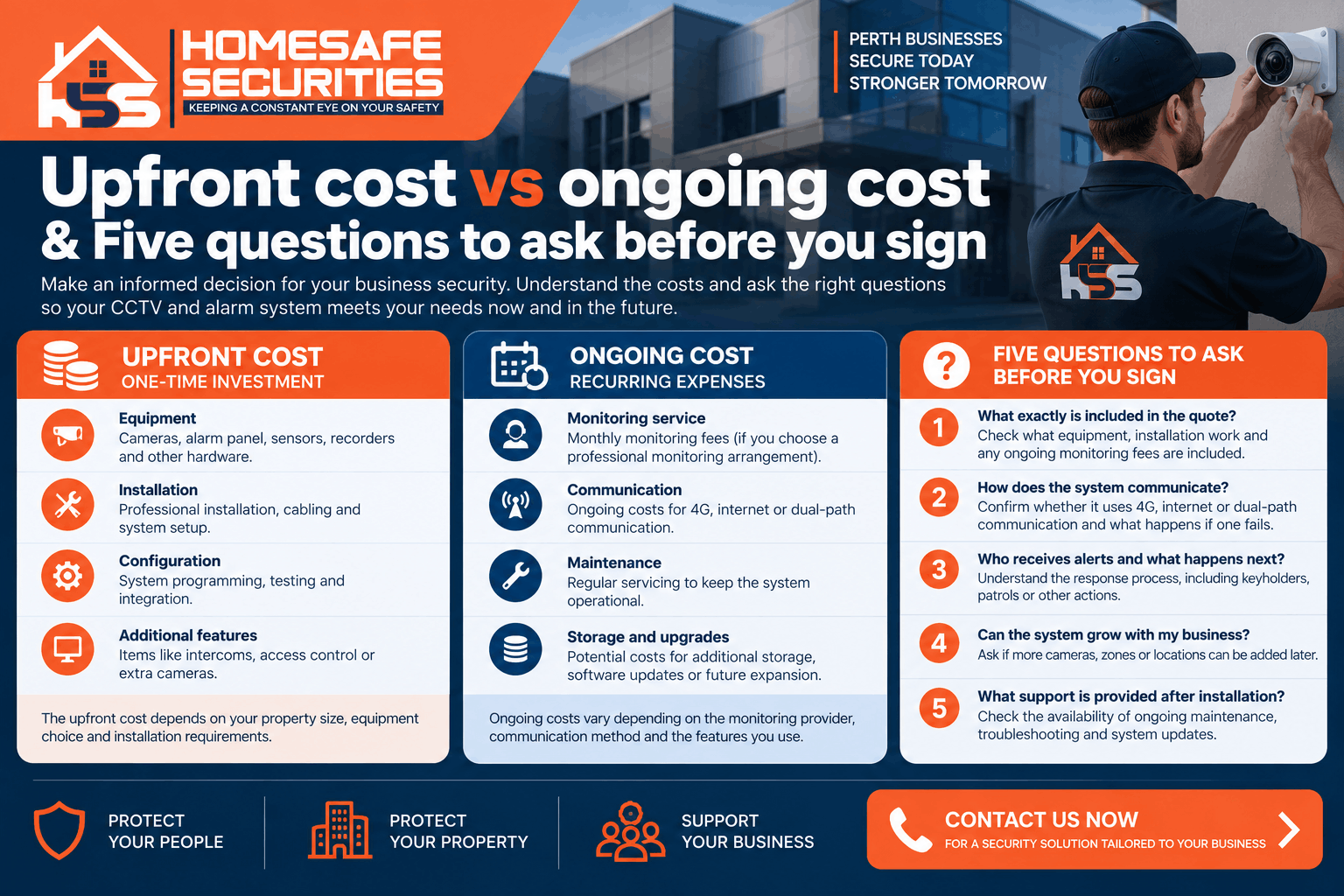
Five questions to ask before you sign
- What exactly operates 24 hours a day? Recording, alerts, monitoring, or a combination.
- Who receives an activation, and in what order? Nominated staff, a monitoring centre, or both.
- What is the written response procedure? Ask to read it rather than assuming one exists.
- Which monitoring centre receives the signals, and what grading does it hold? ASIAL operates a monitoring-centre grading and certification scheme against AS 2201.2:2022, with separate classifications covering building and construction requirements and operational requirements. If professional monitoring forms part of your proposed system, ask which centre is used and what current grading or certification it holds.
- Who maintains and tests the system? Equipment that is installed and forgotten is how communication faults go unnoticed for years.
Getting these answers in writing makes it much easier to compare quotes on actual functionality rather than marketing phrases. When comparing commercial 24-hour security in Perth, assess the alarm system, CCTV coverage and monitoring arrangement against the same response requirements.
Four common misconceptions
“My cameras record all day, so someone is watching them.” Recording means footage is being stored according to the system’s settings. Unless monitoring has been arranged, nobody is watching it at the time.
“The app on my phone is the same as monitoring.” An app gives authorised users access and alerts. It does not create a professional monitoring response — you are the response, and only when you are available.
“More alerts mean better security.” Alerts people stop reading are worse than no alerts. Notifications should be configured around meaningful events rather than every movement.
“Every business needs the same setup.” A single-site office and a multi-site warehouse operation have different risks, hours and response requirements.
Why choose HomeSafe Securities for commercial security in Perth?

HomeSafe Securities is a locally owned and operated Perth security company. Commercial CCTV, alarm and intercom systems are what we work on every day, for retail premises, warehouses, offices, workshops and multi-site businesses across the Perth metropolitan area.
- Licensed Perth technicians. Security installation in WA is a licensed activity, and our technicians are licensed to carry out the work. Our licence details are available on request [insert licence number].
- Systems planned on site, not sold off a price list. Commercial premises differ too much for a fixed package to fit. We quote after walking the property, looking at entry points, hours of operation, lighting and the areas that actually matter to you — which is the same reason our quotes are itemised rather than a vague “from $X” figure.
- Monitoring-ready installations. We specify equipment that can be suitable for connection to compatible monitoring arrangements, so the option stays open whether or not you take it up at installation.
- Established, well-supported equipment. We work with recognised security brands, with proper warranty and local support behind them, rather than whatever is cheapest at the time.
- One provider across the whole system. Commercial CCTV installation, commercial alarm systems and commercial intercom systems planned together, by one team, so the parts work with each other instead of around each other.
- Local aftercare. We are based in Perth and stay available after handover for support, testing and system changes as your business grows.
- Clear pricing. Current packages and inclusions are set out on our pricing page, and commercial installations are quoted individually.
Frequently asked questions
What is a back to base alarm?
An alarm that reports to a monitoring centre rather than only sounding a siren on site. When a sensor activates, the panel transmits a signal over its communication path, and the event is handled according to the monitoring arrangement in place.
Does a back to base alarm still work without a phone line?
It depends on the equipment. Current panels report over 4G cellular, the internet, or both. Older panels built around copper-based phone services may need a compatibility check or an alternative communication method, which is worth confirming if yours has not been tested since your site moved to the NBN.
Is CCTV recording the same as CCTV monitoring?
No. Recording stores footage for live or later viewing. Monitoring means camera events are assessed as part of a separate monitoring process.
Can I monitor my business CCTV myself instead?
Many commercial systems support remote live and recorded viewing through compatible apps. The limitation is availability — alerts only help when you are able to see and act on them. Access should also be restricted to authorised users and configured securely.
What happens if my power or internet goes down?
Depending on the system design, backup measures may include battery power and an alternative communication path such as cellular connectivity. The capabilities vary between systems, so businesses should confirm what happens during a power, internet or communication outage before installation.
Can monitoring be added to an existing alarm?
In some cases, an existing compatible alarm panel can be connected through an updated communication device. Older or incompatible equipment may require additional changes or replacement. An installer should inspect the existing system before recommending an approach.
How much does commercial security monitoring cost in Perth?
Commercial security monitoring costs vary according to the monitoring service, communication setup, property requirements and agreed response procedures. Patrol attendance or other response services may be charged separately. Businesses should ask for installation, ongoing monitoring and potential callout costs to be itemised before choosing a service.
What is the difference between monitoring and a security patrol?
Monitoring is the detection and decision layer — receiving the signal, verifying it where possible, and deciding what happens. A patrol is physical attendance that may follow. These are usually charged separately.

About HomeSafe Securities
HomeSafe Securities provides professional CCTV camera installation, alarm systems and intercom solutions for homes and businesses across Perth, installed by licensed technicians.
We are a locally owned and operated Perth business, working with property owners and business operators across the Perth metropolitan area. Our services cover home CCTV camera installation, commercial CCTV installation, home and commercial security alarm systems, and home and commercial intercom systems.
Every installation begins with a free quote and a site inspection, followed by professional installation, system configuration and a handover that shows you how to use what you have paid for. After that, we stay available locally for support and system changes.
Talk to a Perth installer about your setup
We design and install commercial CCTV and alarm systems that can be suitable for connection to compatible monitoring arrangements, depending on the equipment and service selected. If you already have a security system, HomeSafe Securities can assess the existing equipment and communication setup and identify whether updates may be required.
Book a site assessment and we will walk your premises, review your existing equipment, and set out the options — with no obligation to proceed.
Call 0469 880 624 or 0455 457 431, or contact HomeSafe Securities online to arrange a commercial site assessment.